Future-Ready & Scalable RWA Tokenization Solutions Powered by AI & Web3
RWA Tokenization Solutions Powered by AI & Web3

The convergence of real-world asset tokenization, artificial intelligence, and Web3 is redefining how value is created, managed, and exchanged. From real estate and commodities to private equity and intellectual property, assets that were once illiquid and siloed are becoming fractional, programmable, and globally accessible.
As we move deeper into 2026, the question is no longer whether to tokenize assets - but how to build future-ready, scalable systems that can handle real-world complexity. The answer lies in combining AI intelligence with Web3 infrastructure.
What is RWA Tokenization?
RWA tokenization refers to the process of converting ownership rights of physical or traditional financial assets into digital tokens on a blockchain.
These tokens represent:
Fractional ownership
Transferable value
Programmable rights (dividends, voting, royalties)
Examples of tokenized RWAs include:
Real estate properties
Government bonds
Commodities like gold
Fine art and collectibles
By leveraging blockchain, tokenization ensures:
Transparency
Security
Reduced intermediaries
Global accessibility
Why RWA Tokenization is Gaining Momentum
Several macro trends are driving adoption:
1. Demand for Liquidity
Traditionally illiquid assets (like real estate) can now be:
Fractionalized
Traded on secondary markets
2. Regulatory Evolution
Governments are introducing clearer frameworks, making:
Security tokens more viable
Compliance easier to integrate
3. Institutional Adoption
Banks, asset managers, and fintech firms are entering the space, bringing:
Credibility
Capital
Infrastructure maturity
The Role of AI in RWA Tokenization
Artificial intelligence adds a powerful intelligence layer to tokenized ecosystems.
1. Smart Asset Valuation
AI models can:
Analyze market trends
Predict asset value fluctuations
Automate pricing strategies
2. Risk Assessment & Fraud Detection
AI enhances security by:
Identifying suspicious transactions
Monitoring behavioral anomalies
Preventing fraud in real time
3. Automated Compliance (RegTech)
AI simplifies regulatory processes:
KYC/AML verification
Jurisdiction-specific compliance checks
Real-time reporting
4. Intelligent Portfolio Management
AI-driven dashboards help investors:
Optimize asset allocation
Rebalance portfolios dynamically
Gain predictive insights
Web3: The Foundation of Tokenization
Web3 technologies provide the infrastructure needed for trustless, decentralized systems.
1. Smart Contracts
Self-executing contracts automate:
Ownership transfers
Dividend distributions
Governance voting
2. Token Standards
Standards like ERC-20 and ERC-721 enable:
Interoperability
Liquidity across platforms
3. Decentralized Finance (DeFi) Integration
Tokenized assets can be:
Used as collateral
Integrated into lending/borrowing protocols
Traded globally 24/7
Building Future-Ready RWA Tokenization Platforms
To be scalable and future-proof, platforms must go beyond basic token creation.
1. Modular Architecture
Microservices-based backend
API-first approach
Easy integration with third-party services
2. Scalability & Performance
Layer-2 solutions
High-throughput blockchains
Efficient data indexing
3. Security-First Design
Smart contract audits
Multi-signature wallets
Encryption and key management
4. Compliance by Design
Built-in KYC/AML modules
Jurisdiction-aware token logic
Legal wrappers for asset ownership
5. Interoperability
Cross-chain compatibility
Integration with legacy financial systems
AI + Web3: The Synergy That Powers the Future
The real transformation happens when AI and Web3 work together:
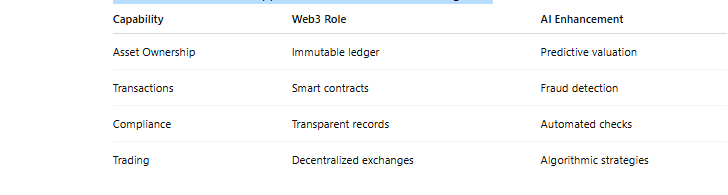
This synergy enables:
Autonomous financial ecosystems
Reduced operational costs
Faster decision-making
Challenges to Overcome
Despite its promise, RWA tokenization still faces hurdles:
Regulatory Uncertainty
Varies across jurisdictions
Requires continuous updates
Integration Complexity
Bridging Web2 and Web3 systems
Managing off-chain data
Security Risks
Smart contract vulnerabilities
Custody challenges
Market Education
Limited understanding among traditional investors
The Road Ahead
The future of RWA tokenization will be defined by:
AI-driven autonomous asset management
Tokenized global financial markets
Seamless integration with traditional finance (TradFi)
Increased institutional participation
As infrastructure matures, tokenization will become invisible yet foundational, much like the internet today.
Conclusion
Future-ready RWA tokenization solutions require more than just blockchain—they demand intelligence, scalability, and compliance at every layer.
By combining:
AI for intelligence and automation
Web3 for trust and decentralization
businesses can unlock:
New liquidity channels
Global investor access
Efficient, transparent ecosystems
The organizations that invest in scalable, AI-powered tokenization platforms today will be the ones shaping the financial systems of tomorrow.